

Low-carbon ammonia just hit cost parity with fossil fueled ammonia. Will it last?
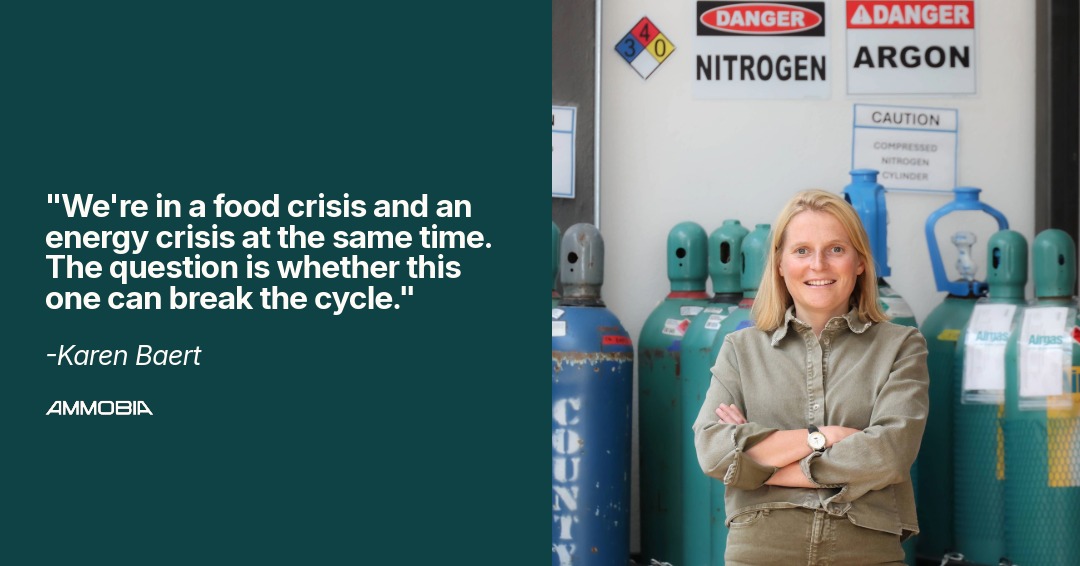
By Ammobia Co-founder Karen Baert, CEO
We’ve seen every major energy crisis follow the same pattern.
Oil prices surge, supply chains buckle, and the world suddenly pays attention to the alternatives it’s been putting on the backburner for decades. Then prices settle, the urgency fades, and we go back to the way things were. We saw it after the 1973 embargo, after the 1979 Iranian Revolution, and most recently after Russia’s invasion of Ukraine.
They say history repeats itself, and we’re watching that pattern play out again right now. The Strait of Hormuz is effectively closed, with the IEA calling this the largest oil and gas supply disruption in history. Virtually all ammonia production relies on fossil fuels. Roughly 30% of globally traded fertilizers are disrupted, as nearly a third of the world's ammonia exports and 36% its urea exports originate in the Gulf. Fossil fuel ammonia is seeing prices spike up to 50% in some markets since February 2026, driven by natural gas costs that have nearly doubled in Europe.
Sadly, communities across Africa and South Asia that depend on Persian Gulf ammonia for their agriculture are already facing acute shortages. Wealthier nations are seeing rising gas and food costs, not yet existential, but a warning sign of how fragile the system is. And because ammonia isn't just a fertilizer input but also an emerging clean-burning shipping fuel and a leading candidate for storing and moving renewable energy, the disruption ripples travel further than most people think.
This is a food crisis and an energy crisis at the same time. The question is whether this one can break the cycle.
Our answer starts with why conventional ammonia production keeps falling short. We’ve been making ammonia the same way since 1914 with the Haber-Bosch process, which demands extreme pressures, high temperatures, massive scale, and cheap natural gas. This is why it stays concentrated in a handful of regions and collapses when supply chains do. So when gas gets expensive, ammonia follows. When gas gets cheap again, the conventional approach wins on cost, and the window closes.
But we’re seeing signs of this react-and-revert paradigm beginning to shift. For the first time, low-carbon ammonia has hit price parity with conventional ammonia in India, according to Quantum Commodity Intelligence. While it still subscribes to previous moments where spiking fossil fuel costs made clean alternatives within reach, low-carbon ammonia costs are also beginning to fall on their own. Years of sustained development, particularly in China, have started driving costs down the same way we saw with solar and batteries: a shining example of what happens when countries think long-term in energy.
Low-carbon ammonia, sometimes called clean ammonia or green ammonia, refers to ammonia produced with significantly lower greenhouse gas emissions than the conventional process. There's no single agreed-upon definition yet, but organizations like IRENA, the IEA, and the Ammonia Energy Association are collaborating to harmonize standards. It comes down to reducing or eliminating the fossil fuel dependency in how ammonia is made, whether through renewable-powered electrolysis, carbon capture, or fundamentally different production technology.
While BloombergNEF makes the case that this war, like the ones before it, is unlikely to produce lasting momentum for low-carbon ammonia, they’re diagnosing the symptom, not the cause. Low-carbon ammonia has never sustained its momentum after a price shock because the underlying production economics have never really changed.
What would it take to make low-carbon ammonia production the default?
Make it cheaper, and more flexible. Change the way ammonia production plants are designed, where they can be built, and whether they can operate outside the supply chains that continue to fall short. All without the premium.
That’s the problem Ammobia was built to solve.
Our Haber-Bosch 2.0 process operates at a fraction of the pressure of conventional systems, which fundamentally changes the economics. Centralization has always won out before because of Haber-Bosch's necessary economies of scale. However, Ammobia's process can match conventional Haber-Bosch's capex on a per-unit-ammonia-capacity basis at one tenth the plant scale, opening the door to distributed production without compromising on ammonia prices.
At a more flexible 100 MW rather than GW scale, Ammobia’s total installed capital costs drop 10x, enabling project financing and progressive buildouts, and plants can match regional power supply instead of demanding dedicated infrastructure.
We also build in modular configurations that can be deployed close to where ammonia is needed - close to farmers facing fertilizer shortages, and close to ports where maritime operators need fuel, outside the shipping lanes that are subject to disruption.
And because the system is feedstock-agnostic, capable of running on renewable, fossil fueled with or without carbon capture, and geologic hydrogen, we can untether production from any single energy source or geography.
The result is ammonia production that’s affordable, diversified, resilient -- and low carbon.
This is a fundamental shift in global energy dynamics.
The way we decide to address the ammonia production and distribution pain points we're faced with today will determine the cost and security of food and energy for the next decade. In fertilizer prices that empower entire regions to feed themselves without relying on a single strait, in shipping fuel that scales, and in whether countries with abundant renewable potential can become energy exporters for the first time.
Whether we use this window or let it close again is the choice in front of us today.
Latest from Ammobia

.jpeg)


Choose the fastest route to low-cost ammonia

