

Why ammonia plants cost a billion dollars
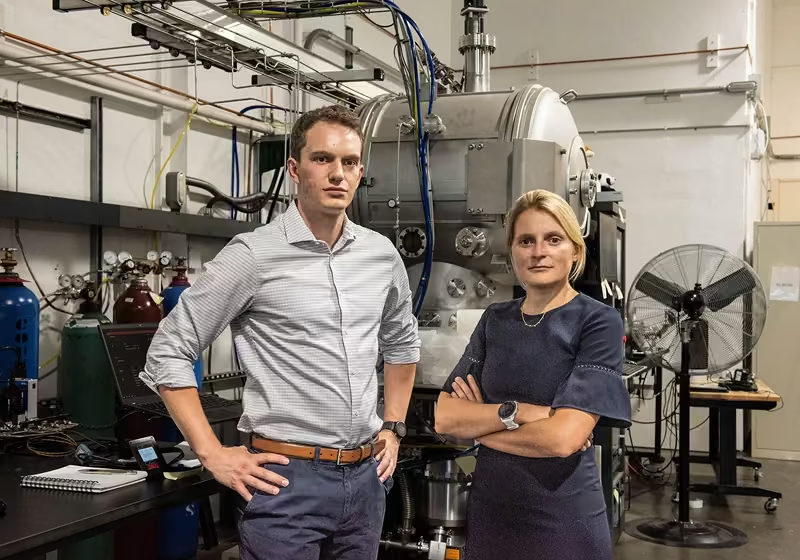
By Tristan Gilbert, Co-founder & CTO, and Guido Radaelli, Chief Engineering Officer
Ammonia feeds half the world through fertilizer production and is quickly becoming one of the most promising clean maritime shipping fuels. An ammonia molecule itself is cheap to make, due to extensive and often fully-depreciated infrastructure that serves historical demand, but a new ammonia plant costs no less than a couple billion dollars. Feeding a growing population and new energy use-cases require new ammonia production, but building new ammonia capacity is a capital challenge that falls victim to the limitations of current technology and historical optimization to mega-scales.
At Ammobia, we started by going after the thing that forces plants to be big and expensive: the famously extreme pressures and temperatures in the ammonia conversion reactor. We developed a lower pressure ammonia process that roughly halves the cost of the ammonia synthesis loop (”synloop,” which converts hydrogen and nitrogen “syngas” into pure liquid ammonia), but ammonia conversion is just one piece of the puzzle. Producing ammonia is a multi-step, multi-player problem, and that is why we’re so excited to announce our partnership with Lummus Technology.
The billion dollar plant
Ammonia is a simple molecule, comprising just hydrogen and nitrogen. Most ammonia supply relies on hydrogen production from natural gas and nitrogen production from air, which uses technologies such as steam methane reforming and its sibling, auto-thermal reforming, usually coupled with an air separation unit and sometimes carbon capture. Water electrolysis is also an option, providing clean hydrogen when paired with renewable energy. Each of these production methods produces hydrogen and nitrogen at between 20-60 atmospheres of pressure (~20-60 bar). They are mature or close-to-mature, and available across plant scales.
Then comes ammonia conversion, which conventionally requires 120-300 bar for commercially viable conversion. To mitigate the capital costs associated with this high pressure conversion, the conventional Haber-Bosch process has leveraged economies of scale, now by default building at the current world-scale of 1000-5000 tons of ammonia per day (tpd). In fact, it’s become so commercially viable that the ammonia conversion portion of the plant represents only about 20% of the project capex and a minor portion of the energy.
Mission accomplished - so long as you can afford a world-scale manufacturing complex. While the specific capital ($/capacity) of these plants is low, the total price tag, especially when considering the hydrogen and nitrogen production and the balance of plant, regularly runs into the billions. Now we have a capital problem, not a levelized cost of production problem, and as a result, only massive global companies with suitable balance sheets are able to finance and build new capacity.
If you want a lower price tag, you could just build a smaller plant. But when you lose economies of scale, the costs for ammonia conversion blow up. Exotic metals, multi-stage converters, centrifugal turbine-like compressors, and specialized on-site fabrication break the economics. The ammonia process now costs 50% of the capex and the project is no longer viable.
The missing link: modular, low pressure, Haber-Bosch 2.0
It’s about doing more with less. Ammobia’s process combines ammonia synthesis and separation in a single step, pulling ammonia out of the reactor as it forms instead of fighting the thermodynamic equilibrium that ties conversion to pressure. This approach lets us run at 20-60 bar, not 120-300, and still convert more gas per pass. In continuous pre-pilot testing, our reactor held about 65% conversion at 30 bar over 1,000 hours, against roughly 15-30% for the conventional process (Ammobia analysis, 2026). Our reactor system does more conversion with less pressure.
When we drop the pressure, the expensive hardware disappears. Producers no longer need exotic metallurgy, and they can use smaller, engine-like compressors and far less steel. The synthesis units fit on truckable modules, built and repeated like a standardized product, and rapidly installed with minimal on-site labor. We call it Haber-Bosch 2.0: up to 10x lower pressure, roughly 100°C cooler, and specific synthesis-loop costs cut by up to half (TechCrunch, 2026; Ammobia analysis, 2026).
Across the full synthesis loop, we’re doing the same with less: our synthesis loop produces the same ammonia with half the specific capex.
What about the rest of the plant?
Now that we’ve made the ammonia synloop feasible at smaller scales, what about the rest of the production chain? That’s where Lummus Technology comes in. Lummus brings a portfolio of hydrogen production technologies, both mature (gas reforming) and emerging (electrolysis), so each project can pick the pathway that fits its scale, cost, and feedstock access. Lummus also complements our expertise in reactor design and modular deployment, with dozens of historical references to up to 20,000x reactor scale ups.
We joined forces with Lummus as part of a strategic development partnership. Ammobia's synthesis loop is the first ammonia technology in its portfolio. Lummus' extensive, proven performance and production guarantees stabilize plant development risks using Ammobia's standardized, modular designs, and together we can deliver anything from standalone ammonia loops to fully integrated ammonia projects.
Hard-to-abate sectors are not transformed by a single component alone, but when a breakthrough meets partners who unlock improvements across the whole value chain. We’re doing more than just stitching our processes together back-to-back: our uniquely low pressure synthesis loop allows a fully integrated process flow that reduces the costs of hydrogen production, too. More on that to come.
What comes next
Today, the only economics that work mean enormous plants few can afford. We’re excited to say that tomorrow looks different: low-pressure, rapidly deployed, and built by partners who solve the value chain together. Ammobia has re-imagined synthesis, and with Lummus, it becomes a whole-plant reality. If you work in fertilizer, shipping, or energy, let's build it together.
Latest from Ammobia

.jpeg)


Choose the fastest route to low-cost ammonia

